Badminton's court is 13.40 m long, 6.1 m wide for doubles, and the net stands 1.55 m at the posts and 1.52 m at the center. Those four numbers are the whole hard skeleton of the sport, and almost every practical question about playing, buying, or building a court resolves against them.
The court's real dimensions and why the net sags on purpose
The 13.40 m length and 6.1 m doubles width are measured to the outer edges of the boundary lines, which means the lines themselves are part of the playing area. A shuttle that lands on the line is in. This is the first thing that trips up players arriving from tennis, where conventions differ and where the net is a rigid horizontal band. Badminton's net is deliberately lower at the centre (1.52 m) than at the posts (1.55 m), and that three-centimetre sag is not an accident of stringing — it is written into law. The reason is practical: the net is tensioned between posts and must be held taut, and a straight top edge across a long span is harder to maintain than one that dips slightly. The sag also matters in play, because a tight net kill or a delicate net shot behaves differently at the middle than at the edges.
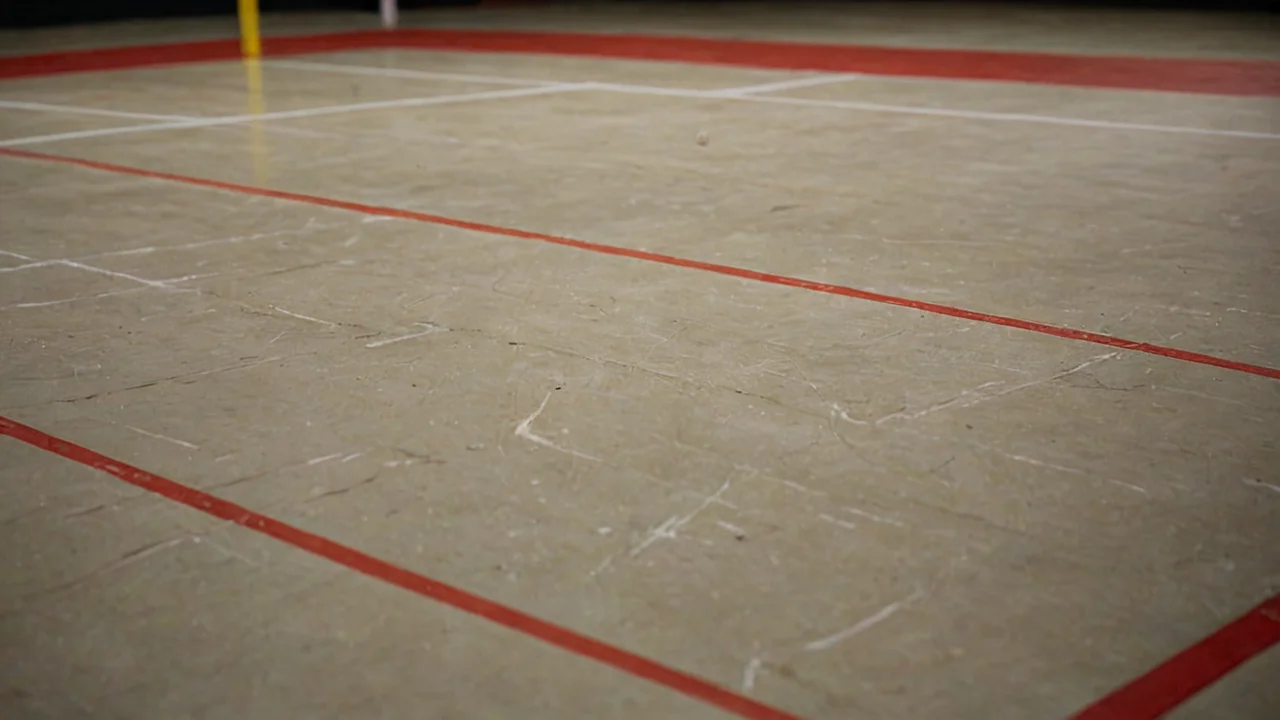
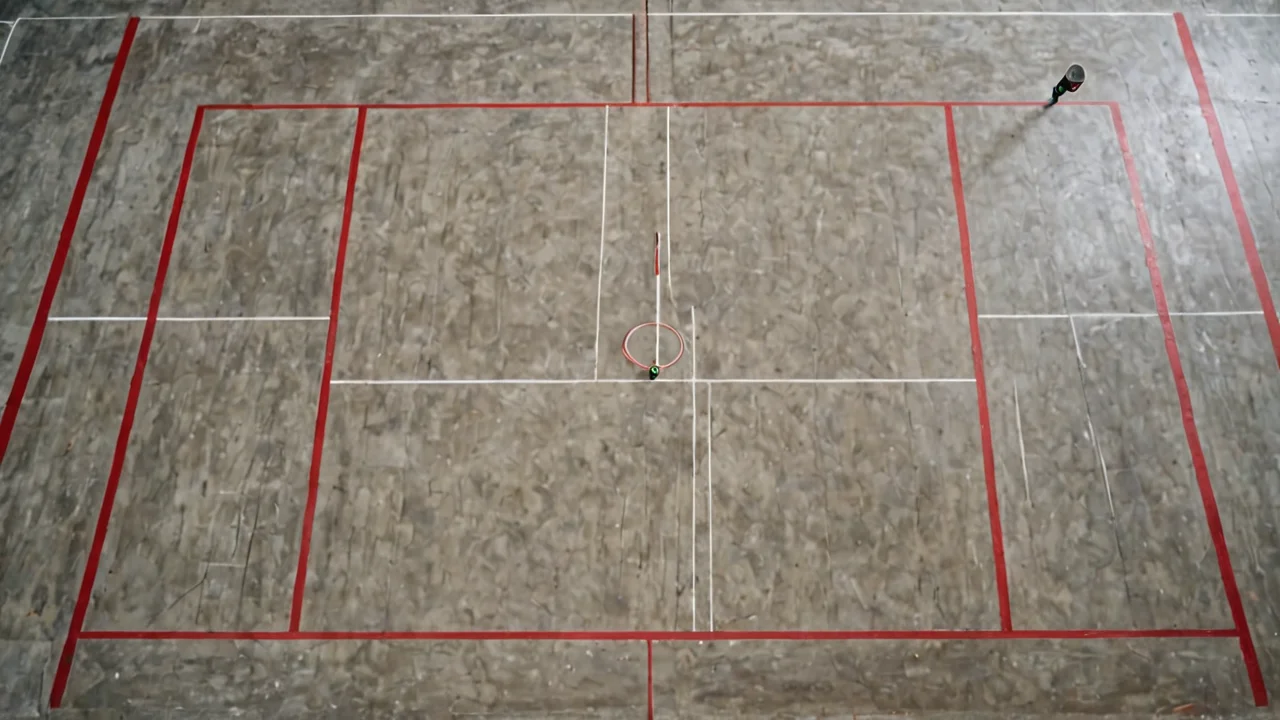
The court divides into a doubles court (the full 6.1 m width) and a singles court, which is narrower — the singles sidelines sit inside the doubles sidelines, and the area between them is out in singles and in during doubles. The back boundary is shared; the short service line sits well forward of the net, and the long service line for doubles sits inside the back boundary, while in singles the back boundary itself is the long service line. This is the geometry that confuses newcomers most: the service court you stand in depends on whether you are serving in singles or doubles, and the lines you must clear change accordingly. Get it wrong and you will serve long in a game where the receiver never moved.
The limits of all this: those figures are the BWF's official law, and they govern sanctioned competition. Club halls, school gyms, and converted barns frequently run short — a hall a metre or two shy of 13.40 m is common — and players adapt with modified service rules or simply accept that the back boundary is closer to the wall than it should be. If you are marking out a court, measure the length first, because length is the dimension you cannot fake. Width can be trimmed by ignoring the doubles sidelines; length cannot be shortened without changing how the game is played.
Ceiling height, run-off, and the space the rulebook doesn't give you
The laws specify the court's footprint but say far less about the air above it and the floor around it, and this is where most home and club courts fail. A shuttlecock hit in a clear or a lift travels steeply, and a low ceiling turns an attacking clear into a fault against the building. The practical consequence is that badminton needs more headroom than most indoor sports of comparable floor size, and a hall that comfortably hosts five-a-side football or basketball will often feel cramped overhead.
Run-off behind the back boundary matters just as much. Players retreat to the rear corner to play a forehand overhead from a deep lift, and if the wall is close, the shot becomes impossible and the footwork collapses. The same applies at the sides, where a lunging net recovery takes a player well outside the doubles sideline. There is no official figure in the laws for these clearances, so treat any number you see quoted elsewhere with suspicion — the honest answer is that you want as much as the building allows, and that a court squeezed against walls teaches bad habits that are hard to unlearn.
What this costs you: a full-size court is not a small room. If you are choosing a space, prioritise length and height over width, because a slightly narrow court still plays recognisably while a short or low one does not. If you are renting, ask to see the hall with the lights on and look up — exposed trusses, low-hanging light fittings, and basketball hoops left dangling are the usual culprits. You notice the problem the first time someone plays a clear and the shuttle clips a beam.
The equipment that has to match the court
A racket's maximum overall length is 680 mm under the official laws, and that cap exists because a longer lever would change how much power and reach a player can generate. In practice almost every racket sold sits at or just under that limit, so the number rarely decides a purchase — but it does tell you something useful: the sport has deliberately frozen the implement's geometry so that the contest stays about movement and touch rather than about who owns the longest frame. The laws also set a maximum width for the racket head, which is why head shapes cluster around a familiar oval or isometric profile rather than stretching into something unrecognisable.
The shuttlecock is the other half of the equation, and it is where court conditions bite. Feathered shuttles fly differently from synthetic ones, and both are sensitive to temperature, humidity, and draughts. A cold hall makes feathers brittle and slow; a warm, humid one makes them heavy and fast. This is why serious players test shuttles before a match and why the same tube can feel wrong in a different building. The court dimensions don't change, but the projectile's behaviour over 13.40 m does, and that changes which shots are viable.
The trade-off here is cost against consistency. Feather shuttles give the truest flight and the best feel for net shots and drop shots — the soft shots played to just clear the net and fall quickly near the front of the opponent's court — but they break, and a hard-hitting session can destroy several. Synthetics last far longer and suit training and casual play, at the cost of a flatter, faster trajectory that makes touch play feel different. If you are learning the game on a slightly short court, synthetics are the sensible choice; the subtlety you are trying to develop isn't there yet anyway.
Marking and building: what actually goes wrong
Mark the lines before you buy anything else, and mark them in the right order: back boundary, then short service line, then the doubles long service line, then the centre line, then the sidelines. The centre line divides the service courts and runs from the short service line to the back boundary; get it off-square and every serve looks wrong. Tape is the cheap route and the one most clubs take, but tape creeps, curls at the corners, and leaves adhesive on wooden floors. Painted lines are permanent and need a floor that can take paint and a building that won't be re-purposed.
The posts are the piece most often botched. They must hold the net at 1.55 m at the posts, and they must be positioned on the doubles sideline — not outside it, which is a common error that widens the court illegally. Posts that sit in weighted bases are portable and fine for a club night, but they shift when a player collides with the net, and you will spend your evening re-measuring. Floor-fixed sockets are better if the building is yours. Either way, check the centre height after tensioning: if the net is over-tightened it will ride high at the middle, and if it's slack it will droop below 1.52 m and kill the net game.
Lighting deserves a mention because it is the invisible dimension. Shuttlecocks are small, fast, and white, and they disappear against a bright background or into glare from a low-hanging fitting. A hall with good floor dimensions and bad lighting plays worse than a slightly cramped hall with even, diffuse light. The cost of fixing it — diffusers, re-aimed fittings, a darker back wall — is usually far less than the cost of the court itself, and it is the upgrade most people skip.
How the dimensions shape tactics and the shots you can play
The 6.1 m doubles width is why doubles is a front-and-back game: two players covering that width can reach almost everything if they rotate, and the mid-court flat drive becomes the dominant attacking shot. In singles, the narrower court rewards length and precision over power, because the corners are closer together and a well-placed clear does more damage than a hard one. The 13.40 m length is what makes the deep clear a weapon at all — it forces the opponent to the back boundary and opens the front court for the drop shot.
Net height governs the touch game. At 1.52 m in the middle, a tight net shot has almost no margin: the shuttle must clear by a hair and then fall steeply, and a fraction too high gives the opponent a kill. This is why the net kill and the tight spinning net shot are the shots that separate levels. The three-centimetre difference between centre and post means a shot played near the post has marginally more room than one played in the middle, and experienced players aim accordingly. The psychology of this is ordinary sports psychology — the study and application of psychological principles to sport, exercise, and physical activity, including performance and well-being — and it shows up as the difference between a player who commits to the tight net shot under pressure and one who lifts nervously.
The limits: none of this tactical geometry survives a court that is the wrong size. On a short court the deep clear becomes a gift, because it lands out or hits the wall, and the whole pattern of singles breaks down. On a narrow court the doubles rotation has less ground to cover and the flat drive loses its sting. If you are training for competition, play on a regulation court as often as you can, and treat the club's odd-shaped hall as a fitness session rather than a tactical one.
Choosing what matters for your situation
If you are building or commissioning a court, the order of priority is length, then height, then lighting, then width, then surface. Length because it cannot be faked; height because a low ceiling removes the attacking clear; lighting because a shuttle is hard to track; width because the singles court can always be marked inside a narrower space; surface because most indoor floors are playable and the others are not worth compromising on. The 13.40 m and 6.1 m figures are your targets, and anything short of them is a compromise you should make knowingly.
If you are buying equipment, the racket's 680 mm cap means you can stop worrying about length and start worrying about weight and balance, which the laws don't constrain and which actually change how the racket plays. Spend your attention on shuttles instead: buy a tube of feathers for match play and a tube of synthetics for practice, and accept that the feathers will die faster. If you are a player rather than an owner, the useful skill is reading a hall in thirty seconds — look up for ceiling height, look down for the back boundary, check the net at the posts and the middle, and notice whether the shuttle vanishes against the back wall. That assessment tells you more about how the session will go than any warm-up.
The one thing to resist is the temptation to treat court dimensions as trivia. They are the reason the sport looks the way it does: the deep clear, the tight net shot, the doubles rotation, the flat drive, the lunging recovery at the rear corner. Change the numbers and you change the game. The official figures are worth knowing precisely because so many courts in the wild don't meet them, and knowing the difference is what lets you train properly in a hall that doesn't.